

A global oil crisis, interest rate rises of a full percentage point, major tax changes, spiralling supplier prices, a cost-of-living weary workforce… the past six months have presented Australia’s property industry with myriad challenges concurrently. However, scratch the surface and it becomes apparent just how resilient the majority of businesses have been in the face of such dynamic trading conditions.
The industry began 2026 on an unsteady footing. The turn of the year saw mounting speculation that 2025’s series of interest rate cuts would be unwound – which came to fruition in quick succession with three consecutive hikes by May, followed by a fourth in September, as inflation once again reared its head.
Yet this was just the beginning of the challenges to come. By March, the US-led war against Iran saw an unprecedented spike in global fuel prices. Housing affordability and cost-of-living constraints saw house prices begin a downturn that continues today. Then, May’s Federal Budget unveiled sweeping tax changes aimed primarily at property investment.
With such rapid and unprecedent change in market conditions, the latest Avdiev Insights Survey report for October 2026 offers a real-time look at the impacts these and other issues are having on the industry and how firms are responding to ensure their balance sheets remain balanced. The comprehensive data within this report allows employers to make well-informed decisions and draw comparisons between their own operations and those of their industry peers across business performance, remuneration policies, management strategies and budgetary scope.
A snapshot of the results is outlined below. Become a subscriber to the Avdiev Report to receive a copy of the full results.
Performance surprises, but fuel prices bite
Given the extent of the residential market downturn and broader economic conditions, it is encouraging to see signs of business resilience across the property industry.
Three in five companies report doing well (48%) or very well (12%) at present. In fact, this marks an improvement on our previous survey six months ago – conducted before the Iran war and Federal Budget – when only 50% of businesses reported the same. A further 36% rated their current performance as neither well nor poor. However, the proportion of businesses fairing very badly doubled over the same timeframe to 4%.
Despite the media headlines and market commentary surrounding the Federal Budget, half of all respondents feel that there has been no net change to their business as a direct result. Those who have been impacted point to pricing as taking the biggest hit, while 4% suggested their compliance burden had actually improved.
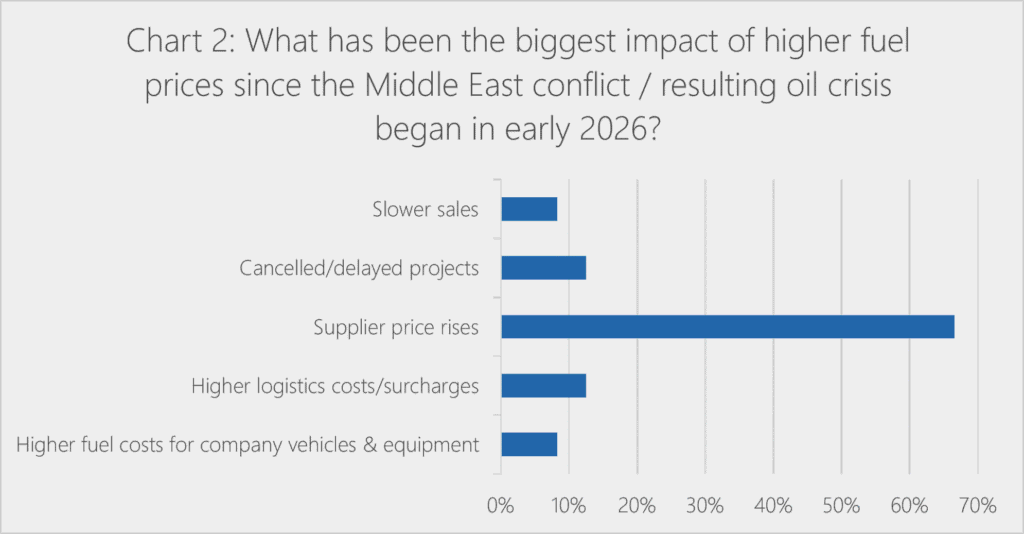
The oil price shock arising from the Middle East conflict is, however, having a material impact, with 13% stating they have been forced to cancel or delay projects and 67% squeezed by rising supplier prices as a direct result of higher fuel costs.
Headcount growth as pay, turnover pressures ease
Remuneration pressures have continued to abate through 2026, with increases in the year to September 2026 averaging 3.5% for junior, 3.8% for mid-level and 3.4% for senior staff. By comparison, remuneration increases for the year to February 2026 averaged 3.9% for junior, 4.5% for mid-level and 4.4% for senior employees.
Most employees received their ‘usual’ full increase, while 6% were deemed catchup rises. No reductions in remuneration were recorded. As usual, there was some discrepancy between sectors and seniority levels, ranging from 2.4% to 4.6%.
Meanwhile, one-third of respondents admitted to difficulties recruiting skilled staff as of September 2026 – a full 10 percentage points lower than the same time last year. As a result, two in three property businesses are no longer struggling to fill vacancies.
And meaningful progress has been recorded in reducing staff turnover rates, led by a dramatic 72% reduction in turnover among senior staff. Falls were also recorded in other staff levels.
On the back of easing hiring pressures and solid retention gains, 40% of respondents said their total headcount is now higher than last year, while 48% reported the figure being largely unchanged.
In focus: training budgets and AI usage
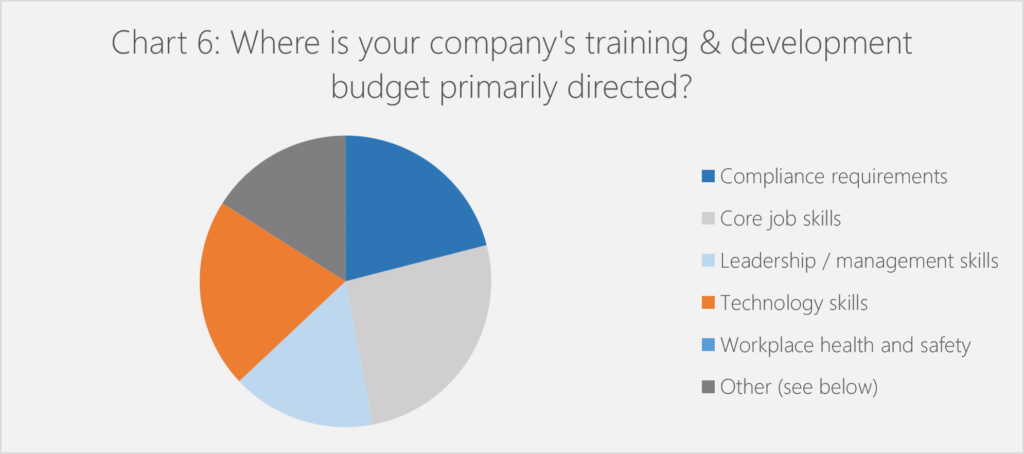
Skills development is attracting increased focus among many property businesses, with 22% increasing their staff training budget in 2026 compared with a year ago, evenly split between marginal and substantial rises. Meanwhile 10% have gone in the other direction by investing marginally less on training. Where this investment is directed was fairly evenly split across four key areas, with core job skills receiving a slightly greater share (26%).
Like virtually every industry, property is seeing widespread uptake of artificial intelligence (AI). Paradoxically, the division with the greatest deployment of AI is also the one where ROI is most lacking so far: 22% of firms point to their accounting and finance division as their primary focus for AI usage, but 33% say they have yet to see meaningful returns from the technology in this space. Varying rates of application and productivity gains achieved were recorded across other business functions including production, marketing, sales, HR, IT and legal/compliance.
We trust this newsletter has been helpful in your remuneration deliberations. If you would like access to the October 2026 Avdiev Report Insights Survey for full sector breakdowns and more detailed analysis of remuneration trends, as well as our spotlight on staff training budgets and AI uptake within the industry, become a contributor to our surveys and remuneration report.
Please contact me directly with any questions you may have or if you would like more information on our products and tailored reviews.