
Employers brace for renewed pain on remuneration

Just as the property industry was seeing conditions stabilise as inflation and interest rates fell, wage and recruitment pressures eased, and business performance improved, the economy now faces an abrupt about-face. Domestic and global factors combined are creating new challenges in 2026, which are reigniting pressure on staffing budgets.
Following several years of restrictive cost of living pressures, 2025 came as a welcome relief for many across the property industry, as trading conditions and economic markers reflected something of a return to more stable settings. Sadly, it didn’t last long.
The resurgence of inflation at year’s end brought an end to interest rate cuts and then sparked fears of more hikes, which have since materialised in early 2026.
Concerningly, even before the Iran war broke out, these pressures were reigniting the fire under wage pressures within the property industry, as workers sought out-of-cycle pay increases in greater numbers. Now, with soaring fuel costs sweeping through the economy, this pressure looks set to increase exponentially.
The latest Avdiev Insights Survey report for March 2026 empowers property businesses with comprehensive, real-time data with which to navigate these and other remuneration challenges as they emerge. It provides employers with a timely opportunity to compare their business performance, policies and budgetary frameworks to industry peers, allowing them to make fully informed decisions.
A snapshot of the results is outlined below. Order your copy today for the full results.
Business performance is glass half full
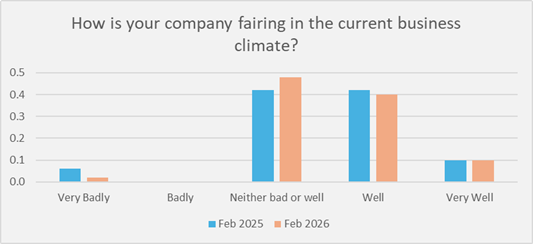
Companies across the industry reported broadly similar business performance results in February 2026 compared with a year earlier, with one encouraging exception: a sizeable drop in the proportion of companies doing very badly.
Just 2% of respondents rated their performance as very bad, down from the 6% recorded at the same this time last year. Once again, no one reported doing badly. For the most part, business performance remained largely static – almost half (48%) suggested they are performing neither badly nor well, slightly more than the 42% recording the same sentiment this time last year. Meanwhile, 40% reported performing well (compared to 42% a year ago) while those performing very well was unchanged at 10%.
However, the picture looks more promising when respondents were asked to compare their own performance to 12 months ago. Almost a third (31%) suggested their company was doing better today, while the majority (63%) felt things were much the same. Only 6% felt they were doing worse than a year ago.
The most upbeat sectors over the past 12 months were PD and PIFM. At the other end of the spectrum, the CONS sector once again dominated the companies doing very badly.
Remuneration pressures rebuilding
Across all sectors, remuneration increases for the year to February 2026 averaged 3.9% for junior, 4.5% for mid-level and 4.4% for senior employees. These increases were lower than a year ago for junior workers (4.5% in February 2025) but higher for more experienced staff (4.1% for mid-level and 4.3% for senior workers). Most workers received their usual standard increase over the year, ranging from 2.8% to 8.6%. Meanwhile, 6% of staff at all levels had a wage freeze in place.
Consistent with previous surveys, this sits above the ABS national Wage Price Index across all industries (up 3.4% over the year to December 2025 quarter) and slightly above the rate of inflation (Consumer Price Index was 3.8% in the year to December 2025).
However, it is the rate at which employers are fielding out-of-cycle requests for pay increases which will be of greatest concern to employers. This time last year, only a quarter (24%) of companies reported receiving more payrise requests than usual. By early 2026, that figure almost doubled to 47%.
Cost of living pressures were, unsurprisingly, nominated as the main reason for the request, followed by matching external offers, value to the company and lastly, market parity.
Notably, our Insights Survey was conducted immediately before the Iran war broke out, the full effects of which are yet to wash through the entire economy. As such, employers are likely to face even more pressure on remuneration, especially in the short term, as soaring fuel costs filter through supply chains.
Skills development under the spotlight
Having previously observed growing emphasis on training and professional development, both as a recruitment/retention strategy and to combat skills shortages in senior levels, our latest Insights Survey included a deep dive into training – including how it is budgeted, where it is directed, and the ROI being achieved.
Two-thirds of companies have expanded their skills development offering over the past year, or intend to do so, as a direct response to recruitment challenges. Most (67%) incorporate a blend of internal and external training opportunities. However, 11% have no formal staff training and development program in place.
Given that 12% of companies fill over half of vacant roles through internal promotion or upskilling, it is unsurprising that leadership and management skills dominated training objectives. Sustainability and ESG knowledge attracted the least investment.
In terms of the ROI achieved, only 6% suggested their initiatives have had “no noticeable impact”, though most are yet to realise the full expected benefits. Companies are also navigating numerous barriers to the delivery of training and development, with a lack of time/project workload pressures cited by 81% of respondents as one key challenge.
We trust this newsletter has been helpful in your remuneration deliberations. Don’t forget to access your copy of the March 2026 Avdiev Report Insights Survey for full sector breakdowns and more detailed analysis of remuneration trends, as well as our spotlight on the state of training and development within the industry.
Please contact me directly with any questions you may have or if you would like more information on our products and tailored reviews.